Friday, April 6, 2007

Piranhas: Fish That Bite Back!


I remember as a kid watching some late night movie about a couple of guys in the Amazon and one fell in the river and was caught in an eating frenzy of a school of piranhas.


I think a lot of us are curious about what it's like to go after these carnivorous fish. Let me tell you, it's a lot of fun. They will hit on just about anything but bacon or raw meat or cut up fish is best. They love to steal your bait when you are fishing for dorado or pintado and will bite your line when reeling in other fish.


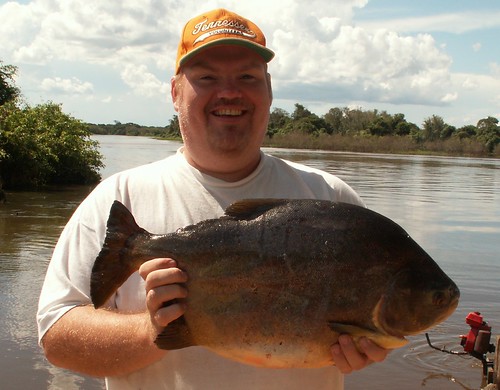
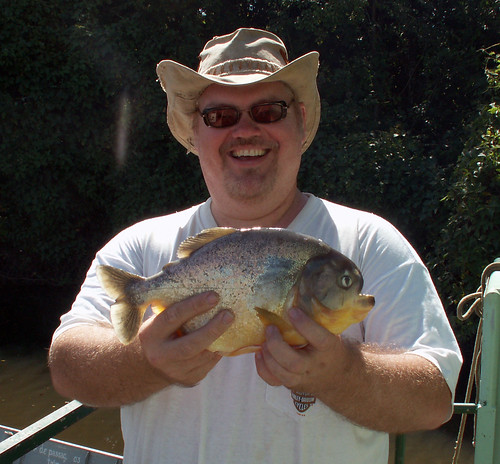
This is a red piranha and they can get as big as 8lbs. This one was almost 5lbs.


You can see by the size of these teeth that this is not something to play around with. We advise our anglers to let their native guide remove them from a hook.

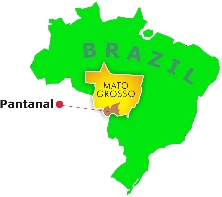
For the most part piranhas aren't dangerous. They won't attack unless they feel provoked or sense fresh blood in the water. It is never a good idea to swim in the Paraguay River is you have some sort of open wound. Piranhas travel in groups with as many as 100.

Fishing for piranhas you want to use a medium action rod, 14-17lb test line and a 3/0 to 4/0 size hook. Most days you can catch as many piranhas as you want, especially if you are using some type of meat that still has blood in it.

Piranhas are delicious and are best fried or in the famous Piranha stew which many believe to be an aphrodisiac. I don't know about that but it is definitely some good eating.

Sunday, April 1, 2007

New Fish Discovered in Brazil


Researchers Rodrigo Moura and Kenyon Linderman began studying a species which many believed to be a snapper that inhabits the Northeast region of Brazil. Bauna or carapitanga was already well known by local fisherman and identified by its six white vertical stripes but researchers realized that this fish had never been cataloged.


Named Lutjanus alexandrei, in honor of Alexandre Rogrigues Ferreira, a 19th century Brazilian naturalist, it has been found as far north as Maranhão down to the south of Bahia. Bauna are predominately nocturnal. They hatch in thick seaside marshes where food and protection are plentiful and then migrate to deep waters. They are usually found around coral reefs.
The information for this article comes from the latest online edition of Pesca e Cia, Brazil's largest sportfishing magazine. The article is only in Portuguese but it can be found at:

Friday, March 30, 2007

Pacu


I've being going on and on in the last few posts about dorado and pintado but the pacu is one of the most beautiful fish in the Pantanal. Most pacu reach a length of about 50 cm (about 20 inches) and can weigh as much as 20lbs (this one was about 12lbs).


Pacu have very large molar like teeth. Though their teeth are quite large (and almost look human) they are not part of the piranha family. They use these large teeth to cut through vegetation and to break open large seeds that fall into the water. (photo is from Claus Qvist Jessen's Fishing and Angling Photos Page - http://www.cqj.dk/fisk-eng.htm )


Pacu are herbivores and although they will hit on live bait, their preference is fruit such as the laranjinha (pictured above). This fruit is native to the prata basin of the Pantanal. Wherever you find a tree by the banks, you can be sure there are plenty of fat pacu waiting to be caught.

The best method for catching them is to tie your boat off to a tree branch and use your heaviest weight to drop your bait right on the bottom. Pacu mainly eat fruit that has fallen into the water so they will look for what's just sitting there.

They are skittish so you have to remain quiet and still but the rewards are great. They are not great fighters like the dorado or pintado but still a great catch.

You'll want to use a medium to heavy action rod, 17 - 20lb line and a 4/0 - 6/0 hook.


This is grilled pacu served with rice, salad and topped with fried bananas. Makes my mouth water just thinking about it. The pacu tastes great and the bones are large so you don't have to worry about swallowing one.
Pacu is just one of the many specialties of the Pantanal and Fish Big Fish fishing adventures. Give us a call to set up your excursion - 1-800-582-2105.

Tuesday, March 27, 2007

Huge Catfish


For the last week or so, I've mainly been talking about dorado. While they are definitely one of the best freshwater sportfish in the world, the catfish of the Pantanal run a very close second place.

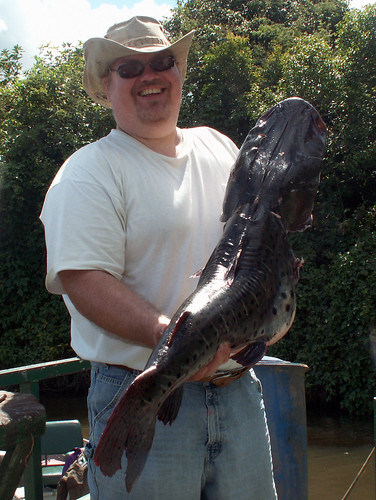
The pintado (speckled catfish) is one of the most prized fish in Brazil. Other cats are the cachara (striped catfish) which is also known as surubim, the barbado (flat-whiskered catfish) which in my opinion puts out a better fight than any of the others, and the monster jaú (giant catfish) which can weigh in at over 200lbs.

All of these cats share the same habitat as the dorado and hit the same bait. You immediately know you have hooked one instead of a dorado because where the dorado will leap out of the water trying to shake loose your hook, the pintado and other catfish will dive down as fast as they can and then try to go under your boat in order to break your line. They are successful on many occasions.

All of them are great tasting fish with the exception of the jaú. I personally like the pintado best. It easily slices up into large fillets and is excellent fried, baked, grilled or stewed. The barbado is best when cut into bite size pieces, batter-dipped and fried. Brazilians call it isca or bait and it is out of this world when served with lemon.

You will not only have a chance to reel in all of these fish during your Brazilian fishing excursion but you will also have the privilege to eat them prepared by our international chef.

When you are ready for your fishing adventure, call us at 1-800-582-2105.

In the meantime, I have prepared a video so you can see what all the excitement of catching Pantanal catfish is all about. Enjoy!

Friday, March 23, 2007

So Just How Tough Are Dorado?


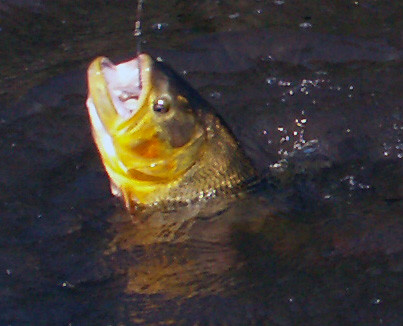
The fishing world has been talking recently about dorado and what kind of fight they can put up once hooked. If you haven't seen the video of their spectacular acrobatic leaps, just scroll down the page and take a gander. If that isn't enough to get your blood pumping and adrenalyne rushing, take a look at this photo.


That's me. As you can see by the look on my face, I am not very happy. Why you ask? Let me tell you. You can see that I am holding two pieces of a fishing rod. A fishing rod that used to be my brand new one piece carbon graphite rod that I picked up specifically for this trip. Now it is a memorial to the fight that one dorado put out our first day on the Paraguay River.

I knew that I should use a medium to heavy action rod but since it was the first week of the season and I knew we would mainly be catching smaller 8-12 lb dorado, I figured a light action rod would be fine. I was wrong and I paid the price.

I also paid the price (or as we say in Brazil, paid the monkey) for only using 17lb test line. I had my line snapped more times than I like to remember. Rogerio figures we lost as many as we caught the first day on snapped lines and because we used hooks too small. Since we pulled in over 30 fish that first day, that is saying something.


Our second day I borrowed a heavy action rod from my new friend Silvio who owns the Tuiuiu Marina in Caceres, Mato Grosso. We also switched to size 8/0 barbed hooks and 30lb test line. After that my line snapped only once but then it was by a monster pintado (speckled catfish). We could see him in the water and estimated he weighed over 60 lbs.

You can bring your own gear from home or use the gear we provide. We use only Shimano reels and we will definitely provide you with the right rods and tackle so you won't have to go through what we did.

But because of the way dorado, pintado and barbado struggle once hooked, we can't guarantee that with even using this equipment you won't suffer a snapped line, bent hook or even broken rod or reel.

When you are ready for this kind of fishing action, give us a call - 1-800-582-2105

http://www.fishbigfish.com/

Thursday, March 22, 2007

Meeting With The Mayor Of Caceres


During our trip to the Pantanal, Rogerio and I realized the importance of developing relationships with governmental leaders in the region. Caceres, in the state of Mato Grosso, is the port city where our expeditions begin. We wanted to make sure that the city officials understand the needs of our clients as well as our desire to be involved in the local community.


We stopped by the offices of Rubens Macedo (on the left, to my right, in the photo), the secretary for the environment and tourism for Caceres shortly after we arrived. We talked with him briefly about our plans to develop more interest for North Americans to come to the Pantanal not only to fish but also to see the natural beauty of the region. He felt we should meet with the mayor and scheduled a meeting for the next day.


Mayor Ricardo Henry (on the right, my left, in the photo) welcomed us to his offices and was excited to hear about our plans. We shared with him our desire to not only develop tourism in the city but also to give back and build a child development center that would later become a children's home.

His wife works in the department of child services and welfare. We stopped by there also to find out about what is required for this type of venture.

All in all we had some great meetings that produced solid relationships with local officials ensuring our clients have the best time possible during their stay. We have heard horror stories about officials in other South American countries causing problems for American tourists. Our friendship with the city leaders of Caceres means that you will avoid any of that unpleasantness and get down to the real business of your trip - FISHING!

The city's website wrote an article about our visit. It is in Portuguese so you probably won't understand much. You can put it through a translator page such as babelfish but I doubt it will still make much sense.

http://www.caceres.mt.gov.br/index2.php?cod_sec=5&cod_sub=15&cod_art=909

Wednesday, March 21, 2007

Caiman Crocodiles of the Pantanal


I have shared about the millions of caiman crocodiles that live in the Pantanal. Here is proof. We went out a couple of nights with an indian guide and this is just one of many caiman we found.

Hope you enjoy.